Introduction
When Kevin Warsh was sworn in as Federal Reserve Chair on May 22, 2026, he inherited a central bank holding rates at 3.50%–3.75% — the result of three 25-basis-point cuts in late 2025 that the market had fully priced and largely moved past. What he also inherited was a combustible macroeconomic environment that is forcing him to confront the possibility that his first act as Chair may be to signal the end of the easing cycle that his predecessor began.
Warsh’s first FOMC meeting — June 16–17, 2026 — carries more market significance than any Fed meeting in recent memory. Not because a rate change is likely. CME FedWatch data shows 95%–98% odds of no change, with prediction markets placing tens of millions of dollars on a hold. The significance lies in what the updated quarterly dot-plot projections will say — or whether they will exist at all.
The March dot plot’s lone remaining 2026 rate cut, already a thin consensus position with widening internal dispersion, is almost certain to be erased at the June meeting. More significantly, Warsh has signaled his intention to pursue what he has called a “regime change in the conduct of policy” — a phrase that has led markets to price a 56% probability of a rate hike by year-end. Morgan Stanley has warned the meeting is the biggest underpriced risk for global currency markets.
Key Developments
Warsh’s Background and Policy Philosophy
Kevin Warsh served as a Federal Reserve Governor from 2006 to 2011, a period that encompassed the 2008 financial crisis and the early years of quantitative easing. During that tenure, he built a reputation for prioritizing inflation control and warning against extended easy monetary policy — positions that put him at odds with the Fed consensus of that era.
His nomination by President Trump on January 30, 2026, followed months of speculation about Jerome Powell’s successor and arrived at a moment when the market was looking for signals about the Fed’s direction beyond 2025’s cautious easing cycle. Warsh took the oath on May 22, formally assuming the chair role.
His stated policy philosophy combines elements that do not resolve neatly. He has expressed more openness to rate cuts than his history might suggest, citing artificial intelligence-driven productivity gains as a potential path to lower rates without reigniting price pressures. But he has simultaneously advocated for a faster reduction of the Fed’s balance sheet — currently near $6.5–6.7 trillion — describing it as central to a “regime change” that pulls back the institution’s market footprint and reduces what he characterizes as financial market distortions. As Allianz Trade summarized: “Warsh combines a dovish view on interest rates with a hawkish approach to the Fed’s balance sheet.”
The Inflation Reality He Faces
Warsh inherited a Federal Reserve with inflation running at approximately 3.8% — well above the 2% target and at a three-year high. The May 2026 non-farm payroll report, stronger than expected, eliminated near-term expectations for rate cuts and pushed Treasury yields higher. April’s core Producer Price Index came in at a 1% month-over-month increase, adding to the picture of persistent inflation pressure.
The Middle East conflict, now in its third month as of the June FOMC meeting, has kept oil prices elevated. Brent crude surged from $72 to $79 a barrel following the initial attacks on Middle East refineries, and the sustained energy price impact is feeding into broader inflation readings. Allianz Trade estimated that the Middle East shock was pushing U.S. inflation toward 3.6% year-on-year in April–May — compared with a 2.8% expectation before the conflict began.
Against this backdrop, several FOMC officials have stressed the need to keep open the option of rate hikes. Futures markets are now pricing a 56% chance of a rate hike by year-end, according to data tracked by BigGo Finance. If that probability rises further following the June meeting, it would represent a complete reversal of the easing narrative that had characterized Fed communication for the prior 18 months.
The Dot Plot Under Threat
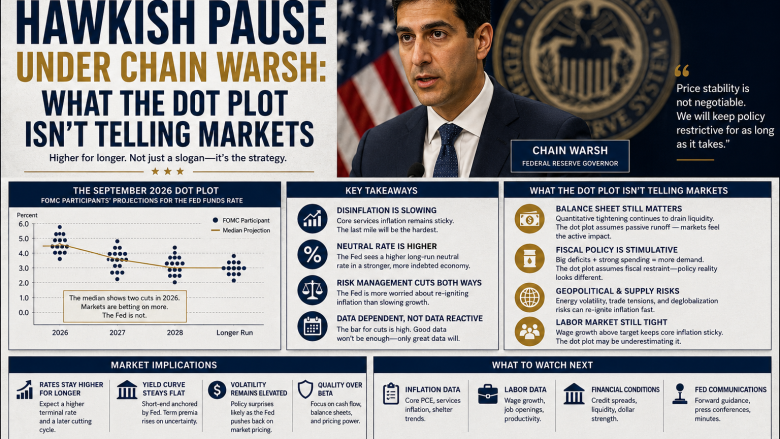
Warsh has indicated his preference for reforming how the Fed communicates policy guidance, including potential changes to the quarterly dot-plot framework — the grid of individual FOMC member projections that markets have come to rely on as the primary signal of the Fed’s rate path. His hiring of conservative policy reformer Paul Winfree and his preference for the Dallas Fed’s trimmed-mean PCE inflation gauge over the standard core PCE metric add further uncertainty about how the June communication will be structured.
The dot plot, as an institution, has been criticized for creating forward guidance that can become self-fulfilling and that constrains the Fed’s ability to respond to new data. If Warsh reduces its prominence or restructures how it is presented at the June meeting, that itself would be a market-moving communication — independent of the underlying rate projections.
Analysis
The June 16–17 FOMC meeting presents markets with an unusual analytical challenge: the outcome that is most likely on the rates side (hold) may be less important than the outcomes that are most uncertain on the communication side (dot plot structure, balance sheet guidance, Warsh’s tone).
For fixed income markets, the key variable is the 10-year Treasury yield. Goldman Sachs observed in its June Market Pulse that the 30-year U.S. Treasury yield has moved above 5%, reaching its highest level since 2007. This represents a significant increase in the risk-free rate that is already filtering through to equity valuations, mortgage rates, and the opportunity cost of holding non-yielding assets. If the June meeting signals a higher-for-longer terminal rate — or worse, the possibility of rate hikes — long-duration bonds face additional pressure.
For equity markets, the relationship between yields and equity performance becomes critical. Goldman Sachs has noted that equity markets are increasingly vulnerable to rising bond yields, and that sharp bond market moves have historically coincided with negative equity returns, with steeper yield increases generating larger equity declines.
The asymmetric risk identified by Morgan Stanley — that this meeting represents an underpriced global market risk — reflects the gap between what markets are pricing (a benign hold with minimal guidance changes) and what Warsh’s stated agenda suggests (a regime change in policy communication, aggressive balance sheet normalization, and a rate trajectory that may trend toward hikes rather than cuts).
What Investors Should Watch
The Updated Dot Plot
The number of FOMC members projecting zero or negative cuts in 2026, and whether any member now shows a rate hike, is the single most market-relevant data point from the June meeting. The March plot showed widening dispersion around the lone 2026 cut. A further shift toward zero-cut or hike territory would represent a meaningful change in the policy distribution.
Balance Sheet Guidance
Any acceleration in the pace of quantitative tightening beyond the current runoff pace would tighten financial conditions independently of the federal funds rate. Warsh’s advocacy for faster balance sheet reduction means this is a live risk that markets may not be fully pricing.
Warsh’s Press Conference Tone
Fed Chair press conferences are as important as the written statement and dot plots. Whether Warsh sounds hawkish on inflation (emphasizing 3.8% CPI, Middle East energy risk, strong labor market) or dovish on growth (acknowledging AI productivity tailwinds, weak consumer at the bottom of the income distribution) will shape the market’s assessment of the rate path through year-end.
CME FedWatch Year-End Hike Probability
A rise in the probability of a year-end rate hike above 60% — currently at approximately 56% — would represent a tipping point in market sentiment that could accelerate de-risking across rate-sensitive asset classes.
Conclusion
Kevin Warsh arrives at his first FOMC meeting in a position that few incoming Fed chairs have faced: inheriting an inflation problem that has reasserted itself, a balance sheet that he believes is too large, and a policy communication framework he has signaled he wants to reform — all while a geopolitical shock keeps energy prices elevated and the labor market remains stronger than the easing narrative requires.
The dot plot may survive the June meeting intact. Rates almost certainly will not change. But what the market does not yet fully appreciate is that the regime change Warsh has described is not primarily about interest rates. It is about the Fed’s entire relationship with financial markets — its communication approach, its balance sheet footprint, and its willingness to let risk assets price independently of central bank support. If that regime change materializes over the coming quarters, the implications for every rate-sensitive asset class — from bonds to equities to crypto — will be significant.
Sources: Bitcoin.com News, BigGo Finance, CNBC, Charles Schwab, Allianz Trade, Goldman Sachs Asset Management, Goldman Sachs, Cryptobriefing.